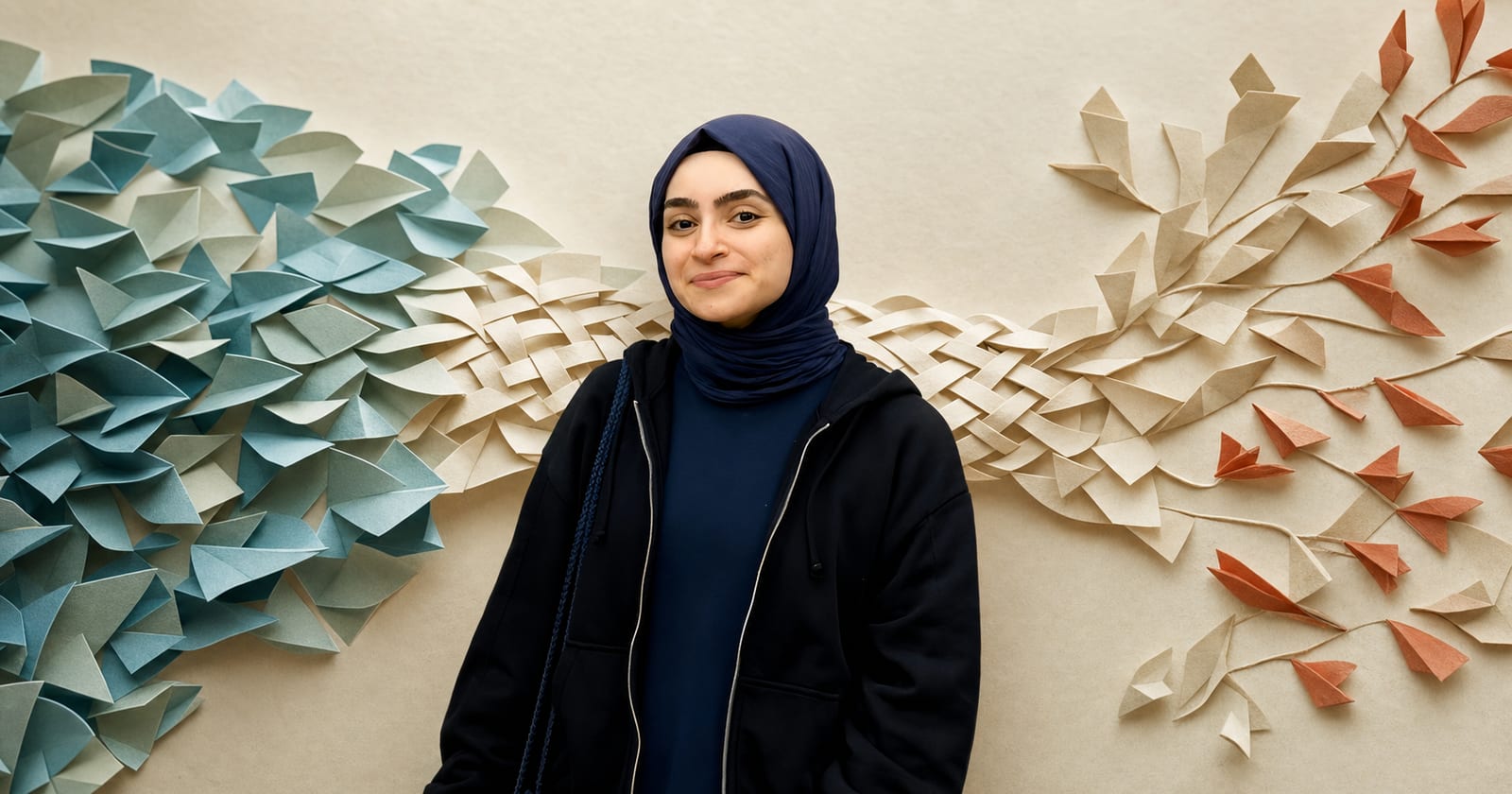
Ebrar Kızıloğlu’s public work moves through mathematics, computer engineering, and language research. The problems have changed along the way, but the emphasis on explicit evidence has remained visible.
She is currently pursuing a master’s degree in Informatics at the Technical University of Munich, on its Machine Learning track. Alongside her studies, she works as a student researcher in TUM’s Chair of Data Analytics and Statistics.
An early practice of difficult problems
Before studying computer engineering, Ebrar represented Türkiye at the European Girls’ Mathematical Olympiad three times. The official competition record lists bronze medals in 2016 and 2018, followed by silver in 2019.
An olympiad result does not explain a later career, and we will not force it into an origin story. It does show that long-form problem solving and carefully checked answers were part of Ebrar’s life well before language models became her research field.
She went on to study Computer Engineering at Boğaziçi University. Her public record also includes software research internships in Google’s text-to-speech group and Google Calendar, bringing academic work into product engineering environments.
Studying what crosses between languages
At TUM, Ebrar researches cross-lingual learnability. In plain terms, that means examining what language models learn in one language and what can transfer to another, including languages with different morphological structures.
The university group’s research programme places that work within broader questions about language models, transfer, and evaluation. Ebrar’s path is especially relevant because it connects German and Turkish, two languages that organize words in notably different ways.
This is careful comparative work. A multilingual system can appear capable while hiding uneven behavior between languages. Making those differences measurable is part of understanding what a model has actually learned.
Building experiments people can inspect
Ebrar’s undergraduate Turing Game project offers a smaller example of the same discipline. The repository includes the implementation, evaluation setup, excluded sessions, results, and remaining limitations for a bot tested with human participants.
Her later work with Boğaziçi University’s Text Analytics and Bioinformatics Lab continued that open-research pattern. Public repositories make the supporting code and evaluation machinery available instead of presenting only a headline result.
That matters because reproducibility is not an abstract virtue. It gives another researcher a way to inspect the assumptions, repeat the test, and find where a result stops travelling.
We are delighted to welcome Ebrar to the first LatentShift edition in İstanbul on 17 October. You can follow her current work through GitHub or connect with her on LinkedIn.