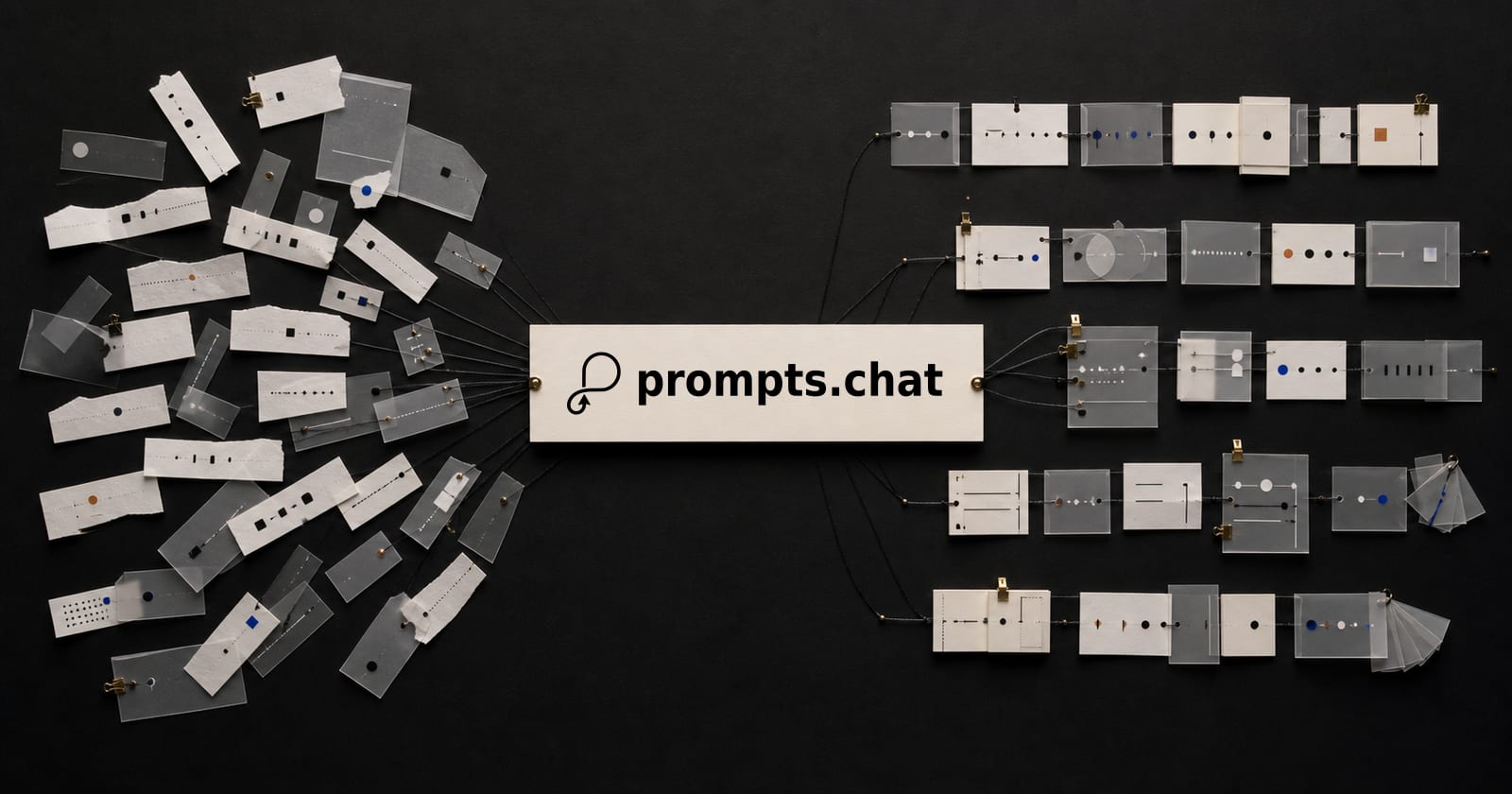
A model gets the attention. The instruction around it often decides whether the result is useful.
In an experiment, that instruction can live in a chat tab. In a real system, it needs to be found, reviewed, adapted, tested, and kept separate from whichever model happens to run it today. When prompts remain private scraps, teams repeat the same work and lose the reasoning behind what changed.
That is what makes prompts.chat interesting. It treats AI instructions as material people can share and improve, then makes that material available as a website, public data, developer tooling, and self-hosted software. We are glad to welcome the project as a gold founding sponsor of the first LatentShift AI Conference.
A personal notebook became a public reference
prompts.chat dates its beginning to 5 December 2022. ChatGPT did not yet have conversation history, so Fatih Kadir Akın created the Awesome ChatGPT Prompts repository to keep useful experiments organized. The repository soon became a place where other people could contribute and reuse what they were learning.
Akın, known online as fkadev and as @f on GitHub, is an Istanbul-based software developer, author, speaker, and open-source advocate. His public work has long combined building with teaching and community organization. prompts.chat follows the same pattern: make the artifact useful, put it in public, and invite others to extend it.
The scale shows how widely that invitation travelled. As of July 2026, the repository has more than 165,000 GitHub stars and 21,000 forks. Its Hugging Face dataset contains about 2,000 entries and has attracted more than 9,700 likes. A star or a like is evidence of reach, not proof that every prompt is good. It does show that a personal notebook became a shared reference point for the AI community.
The important move was from gallery to infrastructure
The original idea was easy to understand: browse a prompt, copy it, and adapt it. The current project carries the same content through several useful forms.
Prompt data is published as Markdown, CSV, and a Hugging Face dataset. Public prompts use the CC0 public-domain dedication, while the application code and project-authored material use the MIT license. That distinction matters. People can study, modify, redistribute, and build on the data without negotiating a new permission layer.
The web application adds categories, tags, variables, collections, voting, comments, version history, and change requests. It handles text, structured, image, video, and audio prompts, as well as reusable agent skills. The MCP-first API lets compatible assistants and development tools search and retrieve that material without sending a person back to a browser. The self-hosted version adds private prompts, configurable authentication, and white-label deployment for teams that cannot place internal instructions on a public service.
Together, those surfaces turn a prompt from a block of text into an object that can be discovered, discussed, versioned, queried, and moved.
A shared prompt is a starting point, not production proof
Prompts still matter in the age of agents because an agent still needs intent, context, constraints, and a definition of a useful result. What changes is the engineering burden around them.
The same prompt can behave differently after a model update, inside another system message, with different tools, or against different retrieved context. A popular prompt can still fail a team’s evaluation set. Copying an example is therefore the beginning of the work, not the end.
This is where openness has practical value. A visible example can be challenged. Version history can preserve why an instruction changed. Portable formats reduce dependence on one model vendor or interface. CC0 removes reuse friction. Self-hosting gives teams a path to keep sensitive instructions under their own controls.
Openness does not remove every dependency. The project’s current owners file lists Akın as its sole maintainer and project lead, while its governance document says the project is looking to grow that group. That is a real concentration risk at this scale. The ability to fork the code and data provides an exit path, but any fork still needs people to maintain it.
Why this belongs at LatentShift
LatentShift is interested in the work after the first convincing output. Which instruction ran? Which model and context did it run against? What changed, who reviewed it, and did the evaluation improve? Can the team roll back when a cleaner-looking prompt performs worse?
prompts.chat does not answer all of those production questions. It does make the instruction layer easier to see, share, and carry into a real workflow. Its path from a README to an open social platform, dataset, API, and self-hostable system is also the kind of evolution we want to examine: a useful experiment acquiring the structure needed by a much larger community.
There is a local connection too. An Istanbul-based creator whose open-source work reached a global audience is backing a new production-AI gathering in his home city. As a gold founding sponsor, prompts.chat is helping us keep community access within reach and invest in the dependable production around the program.
Thank you, prompts.chat
On 17 October 2026, 750 engineers will meet in İstanbul to exchange the details that usually stay inside private repositories, chat histories, and incident reviews. Shared knowledge only compounds when someone does the work of making it legible and available.
Thank you to Fatih and the prompts.chat community for doing that work, and for backing the first LatentShift. You can browse the library, inspect the source, or start with The Interactive Book of Prompting.